
Click here to get 15% off your first order.

Language

Translation missing: en.general.country.dropdown_label

  • Log in
  • Cart (0)
  • Checkout
Tuft the World
  • Shop 
    • Buy our book
    • Kits
    • Tufting Machines
    • Finish your rug
    • Cloth
    • Yarn
    • Frames
    • Merch
    • Gift Cards
    • All products
  • Learn to make 
    • Philadelphia tufting workshops
    • Philadelphia ceramics Workshops
    • Private Parties & Lessons
    • Online course
    • Workshop info
  • Help & Guides
  • About 
    • About us
    • Sustainability
    • Press
    • Fun Articles
  • Tuft in Residence
  • Custom rugs
  • Language

    Translation missing: en.general.country.dropdown_label

Blog

Andie Solar of Myra & Jean: Creating Digital Communities through Craft

June 25, 2018


What was your first experience with fiber art?

Knitting - my grandma taught me to knit a long time ago, and I still remember everything. I used to make clothes for my Barbie. My dad also taught me how to use a sewing machine and I had a lot of fun with it.
space for tufting and fiber storage

What inspired you to start your business, Myra & Jean?

I was laid off in September of 2016 and trying to figure out what to do with myself while looking for a job. Art was a natural outlet - I’ve always loved it and done various versions of it from drawing, painting, to knitting…I loved making something with my hands. I actually just started an Instagram account for fun and not for business. Over time it has evolved into a business and I am beyond grateful.
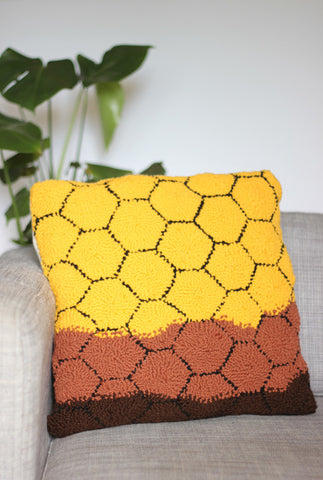
tufted pillow by andie solar of myra and jean

So, where did this passion project get it's name?

The name came to me randomly one night and I loved it. Then someone told me their grandma was Myra and she had a sister called Jean and I thought that was both trippy and cool and I took it in a sense that it was meant to be.

Myra & Jean your full-time job! What is your day-to-day life like, running your own business?

As unbelievable as it still is, yes Myra & Jean is my full-time job. I am very fortunate! Normally, I wake up, check unread messages and my Instagram feed. After I take my son to school I make myself a matcha latte and look at my weekly calendar to see how many kits are due on which day. I work on kits in bulk because it goes faster that way. I make sure to not work on batches that are too big because I can only stretch certain amount of fabric on a frame before my hand starts to ache. Throughout the day, I photograph and post projects I’m working on Instagram. I try to post at least once a day. In the afternoon I fulfill punch needle orders and walk to the post office on the way to pick up my son from school. When we come back I try to work on either a project or kits, depending on the deadline and my energy levels :) Before going to bed I check Instagram again to make sure I engaged with people I follow as well as my followers. I answer every message and comment on social media.
leaf design by rug tufting artist andie solar

How do you create your kits?

The designs usually come to me out of nowhere and the inspiration is instant. I get an idea and know it will become a kit. I draw the image on my iPad and transfer it to fabric. I like to check in with my followers to see what they think of the colors, shape and the size. I love getting their input. Mostly it’s them who get me very inspired!
toucan and leaf wall art tufted by andie solar of myra and jean
After I’ve decided on a design, I carve it out into a stamp pad, which speeds up the production process a lot. I look for yarn that’s the best color-wise and texture-wise. I weigh every yarn ball based on the amount needed for each design and put it in a hand stamped bag. I stretch fabric on a frame, stamp it with the design and add it to the box with yarn and punch needle if one was ordered.
abstract wall art piece tufted by andie solar fiber artist

What are you excited for at this moment?

I am very excited about people enjoying my kits and creating something on their own. I’ve recently started doing workshops and the satisfaction I get from watching someone else working on my kit is indescribable. It’s so much joy! There are a couple of very exciting news coming that I can’t share yet, but I will as soon as I’m able to :)

What influences beyond art and design are crucial to your work?

I am influenced by my interactions with people and watching others create something and grow from it. Being told that I inspired someone to create something makes me very happy and it assures me that I’m doing the right thing.
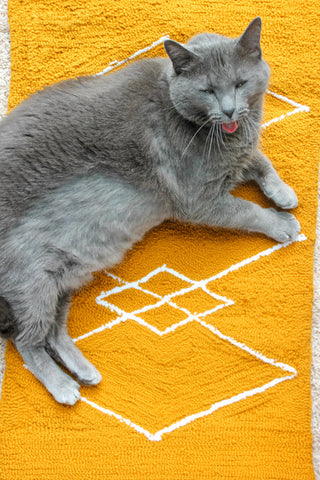
gray cat on a yellow rug tufted by andie solar of myra and jean tuft the world

What made you want to try a rug tufting gun? Do you think it will change anything in your practice?

The idea of creating even loops and being able to work faster is very appealing, especially when it comes to working on larger areas with one color. I really want to try the cut pile one! I have been hand-cutting loops for now and I love the look :) I am not sure how using the gun it will affect me yet. I couldn’t work on anything for a while because I was waiting for fabric, but now that it’s here I can’t wait to get back to it!

Your punch needle kits make fiber art accessible to those who don’t have access to studios or school. What do your accessible designs mean to you?

That’s exactly my goal! I want people to have access - that was why I started making kits in the first place. I love that people get to make something by themselves and the pride and sense of accomplishment they feel afterwards. Most importantly, I want everyone to have fun and be able to relax when working on the kits. I also don’t want them to feel intimidated to start which is why I stretch the fabric and stamp it with the design myself instead of asking them to do it themselves. All they need to do is open the box, instructions, thread the needle and go.

What is your hope for Myra & Jean’s future?

andie solar of myra & jean headshot
I hope to continue this journey and to keep learning from others as I have been until now. The community on Instagram is truly amazing - so inspiring and encouraging. We’re all just trying to learn and have fun so the fact that it’s “community over competition” is very important to me.


Visit Andie’s website for punch needle kits and wall hangings at https://www.myraandjean.com, or find her on Instagram @myraandjean. 

Continue Reading

Kate Garman: Translating Pattern

May 15, 2018

Kate Garman is a carpet designer, an MFA graduate from Tyler School of Art’s Fiber & Material Studies Program, and a rug tufting expert. 

When did you first become interested in the process of tufting?

I used to be a designer with a rug company in Grand Rapids, Michigan. After I got into grad school I really wanted to learn more about the processes we were using within the company. Because of proprietary conflicts I wasn’t able to learn rug tufting there, but it was something I was eager to learn during my two years at Tyler School of Art.

How did working for a commercial rug design company inform your art practice?

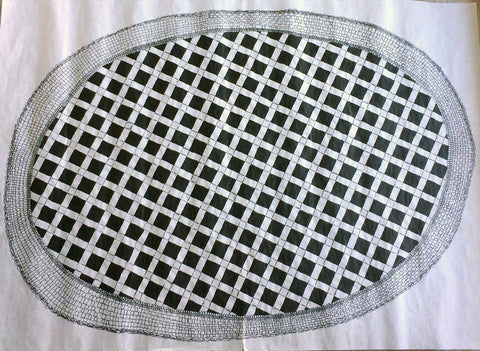
When designing rugs, I created patterns within the grid structure of monk’s cloth [a loosely woven cotton used as a backing in rugs]. It made me interested in ways I could mess with the grid in my art practice. I was obsessed with repeating patterns, especially in black and white, and created a lot of them my first year of grad school. Moving from Michigan to Pennsylvania, I was away from my friends and family for the first time. The move brought up a lot of homesickness which I translated into my drawings. Because I was missing the rug company I decided to create a rug, but this time it was a drawing of a rug. In this process I recreated textile techniques in the form of hand-drawn marks, that for me, were part of a similar meditative process. Working as a rug designer allowed me the opportunity to learn about a niche market, understand the rug-making process, and make lifelong friends.
kate garman fiber artist pattern example tuft the world rug tufting


How did you first learn about Tuft the World? 

I came to Tuft the World because my amazing mentor, Tim, became just as excited about tufting and rug making as I was. In his studio I was finally able to tuft on my own, which has been both overwhelming and challenging. And now I’m the resident rug tufting expert!
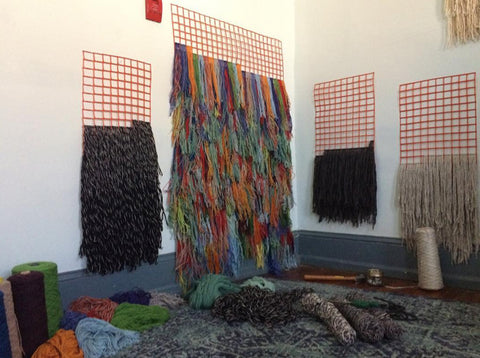
wall hung tufted rugs by artist kate garman

As of now, how would you describe your art practice?

I’d consider my practice a material-based one. As of now, that material is the creation of fabric into clothing. Since graduating with my MFA from Tyler, my practice has shifted into translating my hand-drawn designs into garments.

Where do you see the intersection between your “artist” self and your “design” self? Is there a difference?

I think my design self determines whether or not something is visually working, and my artist self determines that “yes it’s art”. I mean they’re one in the same, because really it’s all me.
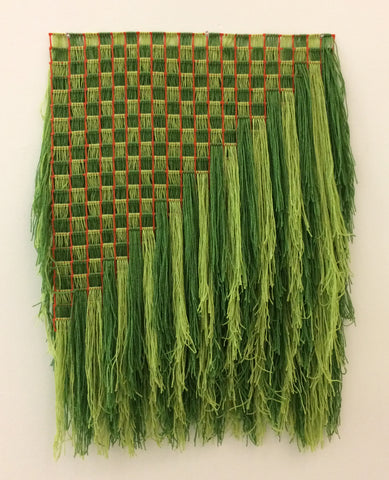
green and red tufted wall art kate garman
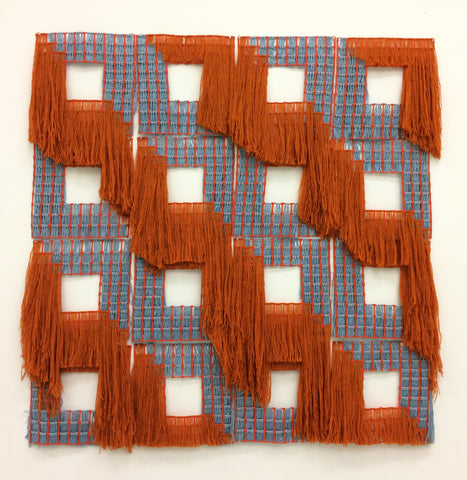
red and blue tufted wall art by fiber artist kate garman


What are you most excited and inspired by?

Right now I’m most excited about making my own clothes. Having just started making clothes within the last six months, I’m still surprised and shocked that I can make something that fits my body and that I want to wear everyday. I’m constantly inspired by the city. Since it’s gotten nicer out, I really enjoy taking walks and I’m always taking pictures of patterns within everyday life that excite me. 
To see more of Kate's work, visit kategarman.com, or find her on Instagram @kategarman. 

Continue Reading

The History of Hand-Tufting: From Pazyryk to Pinterest

May 08, 2018


Persian Rugs: Knots of Identity

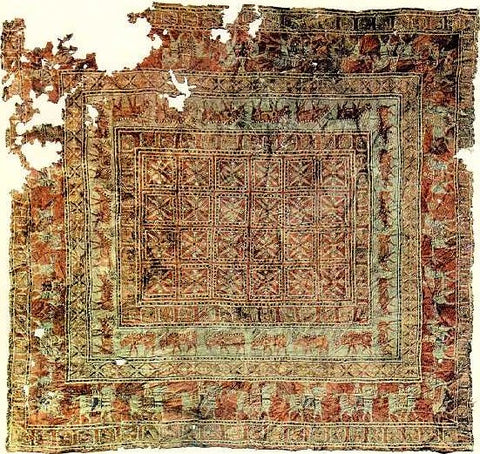
Hand-tufting has an extensive global history. Although believed to originate in nomadic tribes in what is known today as Iran, hand-tufted rugs exist in many unexpected corners of the globe. The world’s oldest existing carpet is dubbed the “Pazyryk Carpet”. It is classified as a Persian rug dating to 5 BCE. Within the compactly knotted rug, a hunting scene depicts images of deer and men riding horses.
One of the first hand tufted rugs made in Persia.
Throughout Persia, the practice of hand-tufting existed in nomadic tribes, village workshops, and royal manufacturers alike. Each region had its own distinctive patterns, wool quality, colors, and even knots used to secure wool to the knitted cotton cloth. During the Safavid dynasty in the late 15th century, a more defined partnership emerged between artists and weavers as they created the most detailed Persian rugs to date, introducing the arabesque style to textiles. Previously, these designs were only seen in tiles and book covers.

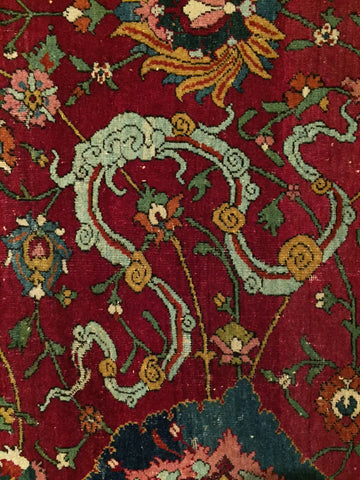
Another example of a hand tufted rug
Centuries later in 1925, the Pahlavi Dynasty originating with Reza Shah once again changed the course of rug making in Iran. The Pahlavi Dynasty encouraged and marketed rug makers in effort to legitimize their regime and establish a strong national identity. However, over the next twenty years a series of monarchs following Reza Shah outlawed nomadism and enforced rigid land programs that decimated the communities in which traditional rug-making flourished. Today, hand-tufted rugs have a small but dedicated client base in Iran. Traditions such as natural dye are continued, as materials like madder root, onion, chamomile, oak, and indigo are used to dye wool vibrant colors.


Detail of a Persian Animal Carpet, Safavid Period, Persia, 16th Century >
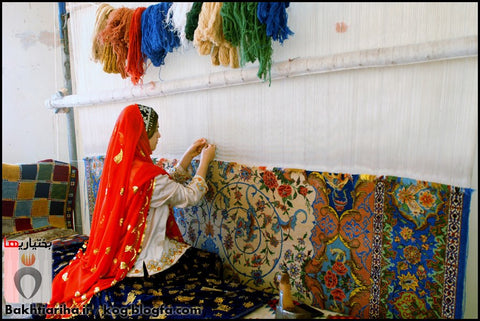
An artisan working on a hand knotted rug

Knotting New Traditions

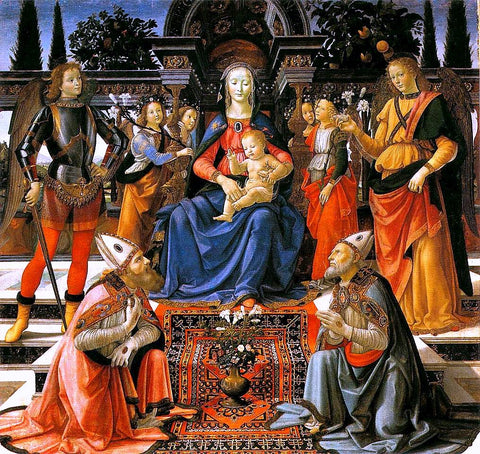
Persian rugs were and still are immensely influential in rug making traditions all over the world. During the crusades in the Middle Ages, hand-tufted rugs were introduced to Europe and Asia. Persian rugs were popular items of trade and have been discovered in Renaissance paintings, Tibetan monasteries, and burial sites along the Silk Road.

< Bakhtiari Girl Hand-Tufting a Traditional Persian Rug 
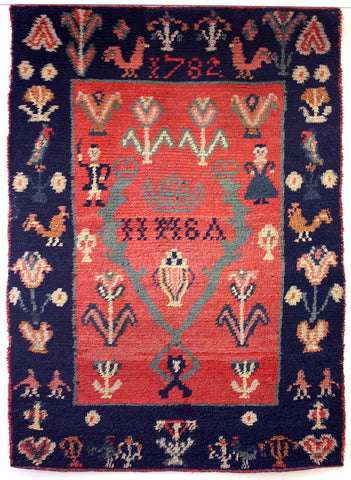
A massive hand tufted rug
The Scandinavian tradition of Rya rug making composed of thousands of knots originated from Vikings trading with Ottoman Empire textiles. In the 1800’s and 1900’s, future brides would hand knot Rya rugs to stand on during the wedding ceremony. These rugs would then be repurposed as insulating duvet covers on the couple’s marriage bed.
Domenico Ghirlandaio, “Madonna and Child Enthroned with Saints”, Florence, 1483 >
Hand knotted and tufted rug

Across the pond, the first mechanized tufting machine was developed in Dalton, Georgia in the 1930’s. Thanks (or not thanks!) to the original tufting machine, chenille rugs and wall-to-wall carpeting became hugely popular in the United States. However, the recreational practice of hand-tufting did not rise to prominence until the 1950’s. When latch-hooking became oh-so-popular in the 70s, hand-tufting lost some of its appeal because its materials were more expensive.
Which brings us to today! Through social media, artists, rug traders, collectors, and fiber fanatics can swap hand and machine-tufted inspiration. It’s safe to say that the rich history of tufting is still in the making.

Continue Reading

Previous 1 2

  • Account login
  • Affiliate program
  • Shopping App
  • Shipping
  • Return policy
  • Terms & Conditions
  • Privacy Policy
  • Contact Us
  • Our top tufting tips
  • Reflect rewards
  • Right of Withdrawl - EU

Language

© 2026 Tuft the World. Powered by Shopify

  •  
  •